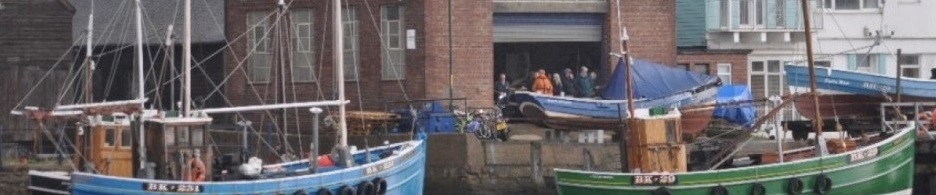
1: Original Missing Archives post was from the years, 2011-2019, and I have managed to fill some of the gaps in them since the post about it was was made and I now wish to review the earlier gap of 6 years, Nov 2002 to Jun 2008. The post of November 2002 till give the reader the main reason for the existence of NEMT and I was one of the early volunteers helping to restore first the Rachel Doulas then the Favourite and during that time that I became a major party to the restoration of historic fishing vessels by the acquisition of Glad Tidings in 2003. It was not long after my purchase that I was told her original name was Peggy so when she was repainted and anti-fouled she was given back her original name and at the same time my name as her owner was painted on her port aft quarter:-
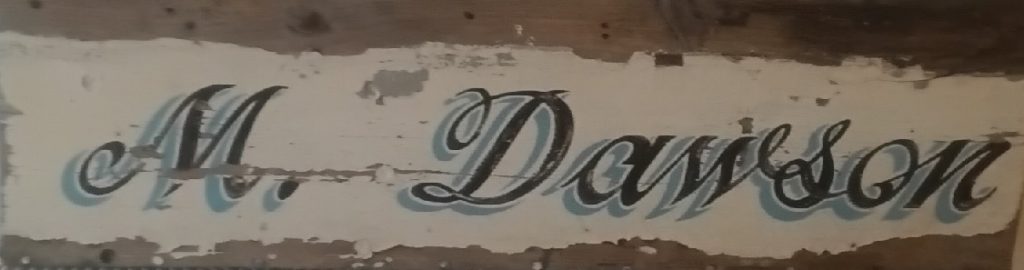
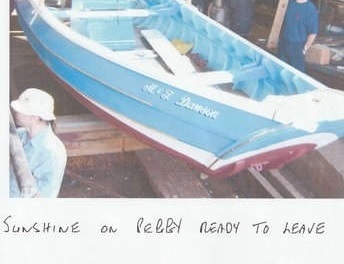
2: The name, M Dawson as the owner of Peggy remained on her port quarter while she was in the care of the South Shields Angling Boat Club and she sat on quayside at the Angling Boat Club for a good while before she could to put into the care of the only wooden boat restorer on the Tyne, Fred Crowell. In the meantime, I had to wait to put her into what I knew as Fred’s Shed because she had to join a queue because he had been asked, by more senior members of NEMT than I, to modify the seine-netters, Rachel Douglas and Favourite to make them more suitable for pleasure use and I made myself useful by helping with their restoration during that time.
I found after some research, mostly by looking at what had been done to put other cobles back into sail that it was relatively easy to determine how long the mast and yard to be compared to her length and while Fred made them out of old telegraph poles, a sailmaker was found to make the sails to fit them.
While Fred goes into some detail about how cobles are built, in his tale about the saving of Peggy, it is not until the 23rd page of The Saving of The Peggy that see much about the mast and yard and more importantly, we also see that the ownership now includes Tim Dawson and that’s him helping to remove the mast from storage so that it could be put back in her prior to the launch,i.e. leave the shed.
3. It appears that some of the wood used to replace some of Peggy’s planks had not all been properly seasoned but this was of no import for nearly all of her new planks were to be well painted, including the ones directly supporting the gunnels.
The gunnels have to be fixed by bolting them to the stempeice, then the knees connecting them to the thwarts and finally bolting them the plank across the stern which supports the rudder and is known as the scut.
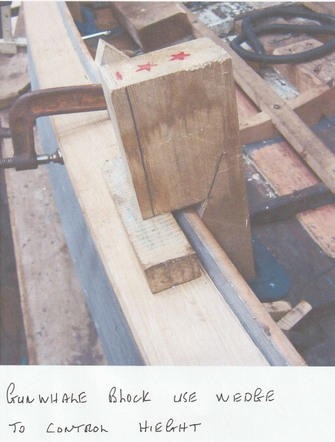
The top plank and the gunnel are then rounded off to make them comfortable to sit on and care should have been protect them from the weather. Sadly, this was not done, either on my watch or when I sold her to the NFHT and she needed a major repaint and while that was being done the owner’s name was changed again – to Charlie Lowdon.
It was a good while before I discovered the lie that Charlie had ever owned Peggy by painting his name on the port quarter and was rather annoyed that both Tim and I had been written out of the history of her preservation by a sleight of hand. If I’d been asked by the NEMT member(s) who commissioned the change of ownership to Charlie they would have been given short shrift and I would have told them that as Charlie had done so much more to help with the preservation of the Henry Frederick Swan than he had with the preservation of Peggy.
I also felt that it would have been more honest to make a plaque for him to go on the aft cabin of the HFS next to the one awarded to J Dudman than to falsely claim that he was ever an owner of Peggy.
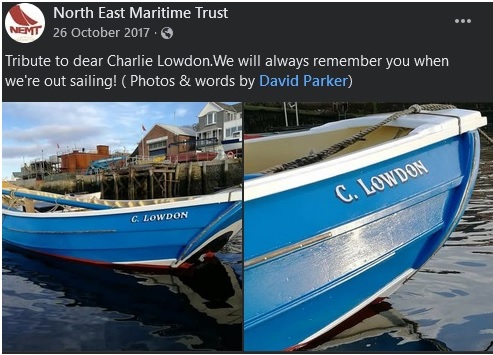
If the author of the lie that Charlie had ever owned Peggy had asked me for permission to write Tim and myself out of the history of Peggy’s preservation, it would have been denied as I knew there was at least one better alternative to honouring Charlie Lowden’s work.
Mick Dawson
09-September-2026
Apologies for not including the last illustration on the first draft. MD